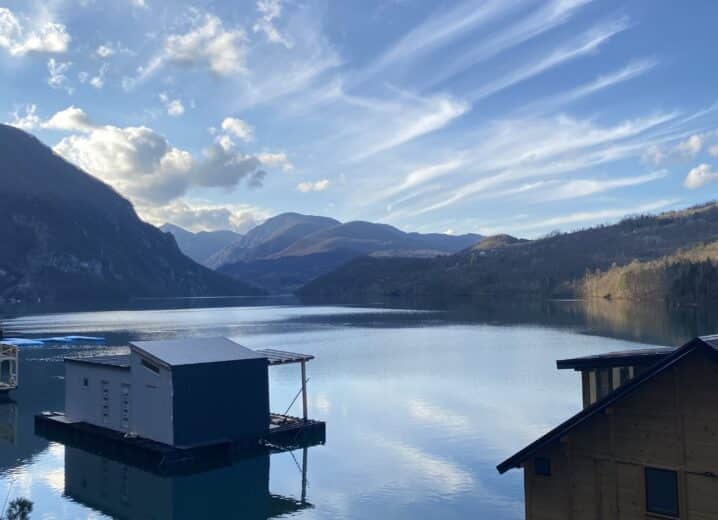
Description
This blog post is written by Louise Coram-Lasnier, an environmental governance professional from New-Zealand specialising in cross-border collaboration and sustainability policy. Drawing on her field research in the Western Balkans, she shares her personal experiences and reflections on the challenges of transboundary water cooperation along the Drina River.
My Journey Researching Cross-Border Cooperation along the Drina River in the Western Balkans
By: Louise Coram-Lasnier
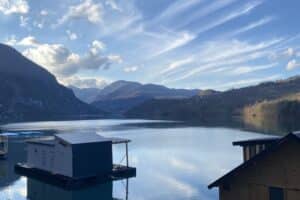
In Serbian, the Drina River is referred to Kriva Drina, meaning both “curved” and “guilty”. The deep turquoise river bends through mountains, borders, and history, carrying with it unresolved blame for dividing people that were once united. What was once a national river as part of ex-Yugoslavia is now an international one, flowing between Montenegro, Bosnia-Herzegovina (BiH) and Serbia. Today, the Drina does not just divide territory; it exposes how conflict lingers long after violence ends, shaping how shared resources are governed or neglected.
I first saw the Drina River from the small window of my shuttle bus. I was on the BiH side of the river and could see the Serbian flags on the other side. Coming from an island, this was the first time I visually observed how human, political, and environmental complexities come into play in the management of a shared resource. In this research, I studied the key stressors and facilitators in cross-border water management – the factors that facilitate or block cooperation between the states. The verdict? The expected stressors continue to block cooperation, and the potential facilitators are affected by deep-rooted post-conflict challenges and political resentment.
The Journey
At the start of this research, I planned to interview government departments across Montenegro, BiH, and Serbia. I sent over 70 emails, called government offices, asked anyone I met for possible leads, and even downloaded local community chat apps. But I received very few responses. I decided to narrow my geographic scope to BiH and Serbia and broaden my interviewees to include Non-Government Organisations (NGO’s) and Intergovernmental Organisations (IGO’s). After securing seven in-person interviews and travelling to the region on the ground, I got to experience how field research is not as straightforward as academic literature makes it out to be. Real-world fieldwork involves complex and sometimes uncomfortable human dynamics. As a foreigner and a woman, I encountered some stakeholders who dismissed my presence, framing water governance and politics as “male territory.” One interviewee agreed to an interview if I kept the camera on so they had “something nice to look at” while answering questions. Navigating these prejudices was a lesson in how traditional power structures, identity, and gender dictate who gets a seat at the decision-making table.
But this journey had two sides to it; while some institutional actors met me with scepticism, other stakeholders welcomed me with open arms. Through this experience, I met some of the most genuine and passionate people, who shared their stories and experiences over a few glasses of rakija. I left the Balkans with a strong understanding of governance systems, environmental pressures and a lasting desire to return to the region.
Findings
One of the clearest insights from my research was that the Drina’s governance challenges are not unique and reflect broader patterns across the region. The challenges in effective cross-border river management come from a lack of political will and state commitment to implement certain projects. When cross-border river management breaks down it leads to: biodiversity loss, ecosystem collapse, and water scarcity. This affects communities by cutting off the water needed for crops, livelihoods, and basic survival. Both BiH and Serbia face limits in institutional capacity, which affects how effectively laws and regulations can be enforced. In theory, sharing a river should encourage neighbouring countries to work together. In reality, it is challenging and post-conflict political engagement creates massive roadblocks. Political distrust, fragmented laws, and lack of funding constantly stalls joint environmental projects. Despite these challenges, the prospect of EU accession remains the most promising facilitator and would provide a framework to improve transparency, harmonise policies, and address weak institutional structures in exchange for joining the EU.
While formal institutions are failing, human connection is not. True progress in the Drina basin will come from the bottom up through the informal networks of young scientists, activists, and citizens who see the river as a shared lifeblood rather than a border.
During my stay in Bajina Bašta (Serbia), the hostel owner did not speak a word of English, but through a lot of hand gestures and some Google Translate, he picked up on what I was researching and wanted to get involved – he drove me around the town, connecting me with locals and helping me gather information about the Drina River from the tourist centre. He came to check on me every day, offering me Burek and introducing me to his friends on voice call. While we didn’t share a language, we shared appreciation for the Drina and pushed for its protection. It was a clear reminder that while formal institutions often struggle to collaborate across borders, local communities already share a deep alignment through the river itself.
Lessons
My time along the Drina taught me that environmental policy is not reserved for politicians and closed rooms; everyone can play a part in advocating for shared resources in their own way. While the field can be intimidating and unequal, understanding how communities live, adapt, and share resources is a key to unlocking ways to cooperate beyond institutions.
In an age when water protection, climate action and cooperation are pivotal, don’t wait for permission to be part of change: dive in, do the research, and take up space at the table.